


The selection of the ideal corridor and inset of a progressive power lens (PPL) ensure good vision quality at all distances and convergence when patients look thought the different part of the lens and it is key to guarantee a correct adaptation process.
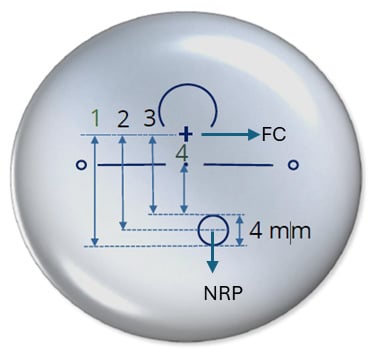
Regarding lens corridor length, there is not a clear definition by the Vision Council of America (VCA) standard, so each lens manufacturer has a different definition (Figure 1), and this may lead to mistakes when Eye Care Professionals (ECPs) must choose the corridor of a PPL. For example, Horizons Optical determines it from the fitting cross until the bottom of the near zone circle which is 2mm below the Near Reference Point (NRP) matching with the minimum fitting height (MFH).
|
Figure 1 Corridor definition of different ophthalmic progressive lens providers |
1–Corridor definition for Horizons: From 14mm to 20mm 2 –Other corridor definition: From 12 mm to 18mm 3 –Other corridor definition: From 10 mm to 16mm 4 –Other corridor definition: From 8 mm to 14mm |
Furthermore, all lens providers offer a lot of corridor options, so this also leads sometimes to not knowing which the best option is to choose by ECPs.
There does not exist a unique recommendation to select the proper corridor length because it depends on many factors, but it is important to consider some tips described below when a patient renew his PPLs:
- Addition: If the addition of the patient increases, the unwanted lateral astigmatism of the lens increases for the same corridor length, so in case of high additions, long corridors are usually recommended and vice versa.
- Previous lens corridor: If the patient is used to a short corridor length, it is recommended to maintain it or at most enlarge 1-2mm in case the addition increases to avoid the effect of unwanted lateral astigmatism increase and if the patient is used to long corridor length, avoid choosing short ones.
- Fitting height (FH): Select the corridor length according to the distance from the pupil heigh to the bottom part of the frame (FH) to ensure that the near prescription is located inside the frame. If a corridor larger than pupil height is selected, then the near area will be out of the frame and the patient will not see at near.
Additionally, lens manufacturers have developed different systems to automatically determine the best corridor and inset of a PPL. In case of Horizons Optical, Ergo Path technology determines the ideal corridor according to:
- Vertical Rotation Angle: Vertical rotation of the gaze when looking from far to near through a PPL. This angle is defined considering the prismatic effect of positive and negative lenses, Back vertex distance (BVD), Pantoscopic and Wrap angle.
- Inset: It is determined considering corridor and convergence determined by near pupilar distance (PD) and working distance (WD).
CONCLUSIONS
The correct selection of corridor and inset of a PPL is crucial for patient adaptation. The expertise of the ECP, the study of the characteristics of the previous lens and the advanced automatic selection of the lens corridor that lens provider offers guarantee a correct selection and ensure a good lens performance.
REFERENCES
Horizons Optical.
}